



Product Categories


Products
Choosing the right laser seam tracking system depends on your joint type, plate thickness, and welding process. Below you'll find our complete range of seam tracking sensors and seam finding sensors — six series covering zero-gap joints, thin sheet metal, medium and heavy plate, wide-field-of-view applications, general-purpose robotic welding, and special-purpose welding machines.
Every series shares the same core architecture: a laser sensor that captures real-time 3D seam profile data, paired with our CuteWelder host control unit that communicates with the robot or PLC to correct the welding path on the fly. What differs between series is the optical design, viewing distance, and gap-detection sensitivity — which is why picking the right series matters more than picking the "most advanced" one.
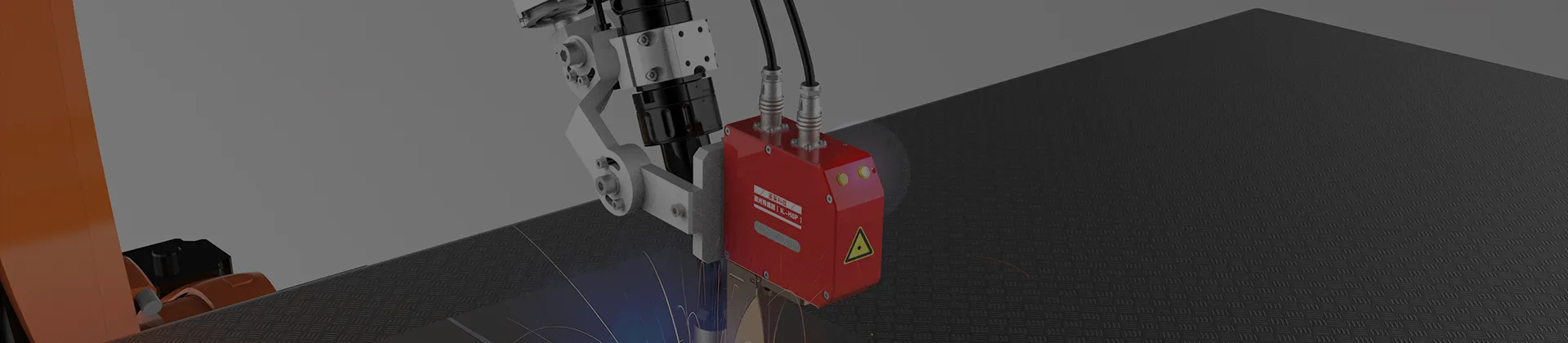
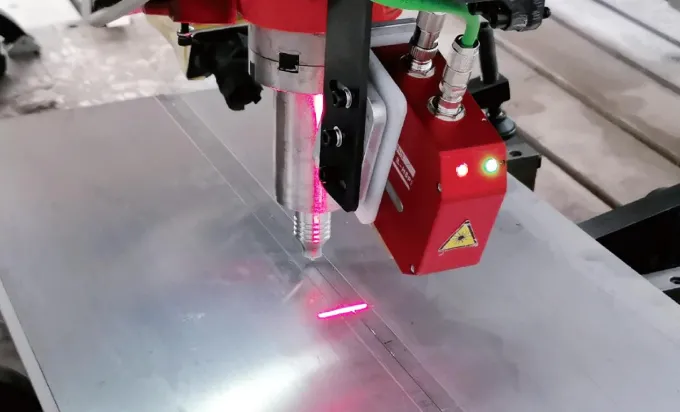
A laser seam tracking sensor uses laser triangulation to project a structured light line across the joint and capture its 3D profile with a camera. The sensor calculates the exact position, width, and depth of the seam dozens of times per second, then sends that data to the host control unit.
The host unit runs the path-correction algorithm and communicates directly with the robot controller (KUKA, FANUC, YASKAWA, ABB, and 40+ other brands) or with the PLC of a special-purpose welding machine. Instead of relying on a pre-taught, fixed path, the robot continuously adjusts its torch position to follow the actual joint — compensating for part tolerance, fixture misalignment, and thermal deformation during welding.
Depending on the series, this works in three modes:
Seam Tracking (real-time): the sensor scans just ahead of the arc/laser and corrects the path during welding.
Seam Finding (pre-weld): the sensor scans the joint before welding starts to locate the start point and overall path, then welds along the corrected program.
Pre-Scanning: a single scan plans the path for multiple welds on complex workpieces, reducing programming time on parts like corrugated plate or container panels.
Welding robot compatibility
The seam tracking sensors of the Intelligentlaser PF series are compatible with the following welding robots:
✔ KUKA
✔ FANUC
✔ YASKAWA
✔ ABB ROBOTS
✔ Panasonic
✔ Kawasaki
✔ OTC
✔ STAUBLI
✔ Reis
✔ STEP
✔ Igm
✔ CHAIFU
✔ TURIN
✔ AUBO
✔ JAKA
✔ MOKA
✔ HUAYAN ROBOTICS
✔ GSK
✔ EFORT
✔ ESTUN
✔ CROBOTP
✔ SIASUN
✔ QJAR ROBOT
✔ PLC-based welding machines
✔ LNC
✔ INEXBOT
✔ SYNTEC
✔ SIEMENS
✔ OMRON
Everyone knows the situation: components are inspected after welding and often weld seams are found to be off position or of poor quality. The cause: poorly jigged parts or problems with parts that were not prepared correctly. These defects cannot be compensated for in the welding process because the robot follows its programmed path, resulting in rework or, in the worst case, rejects being produced.
With a sensor for weld seam tracking, rejects or expensive reworking can be avoided from the outset. Such a sensor also increases the quality of the weld seams, as even minor deviations on the component are recognised directly and compensated for in real time. Because the sensor ensures that the weld seam is correctly positioned, the welding speed can usually be increased, without wasting time and material on excessively large weld seams.
The laser vision seam tracking sensor is a core device for high-precision seam tracking, specially designed for welding of complex groove shapes and high-reflectivity materials. It can effectively avoid defects such as incomplete penetration and undercut. The core information is summarized as follows:
1. Core Principle
A laser projects stripes onto the weld seam, an industrial camera captures the contour image, and an algorithm analyzes the groove position, gap and misalignment. The data is fed back to the control system in real time to adjust the welding torch posture.
2. Core Advantages
It features high precision, is suitable for complex groove shapes such as V-type and U-type as well as multi-layer and multi-pass welding; compatible with high-reflectivity base materials like stainless steel and aluminum alloy; supports various welding processes including arc welding and laser welding.
3. Key Usage Points
● Install a splash-proof protective lens to prevent welding fume and spatter from blocking the light path;
● Complete parameter calibration according to base material thickness and groove shape to ensure accurate detection;
● Cooperate with pre-welding base material cleaning and standardized groove design to maximize the defect prevention effect.
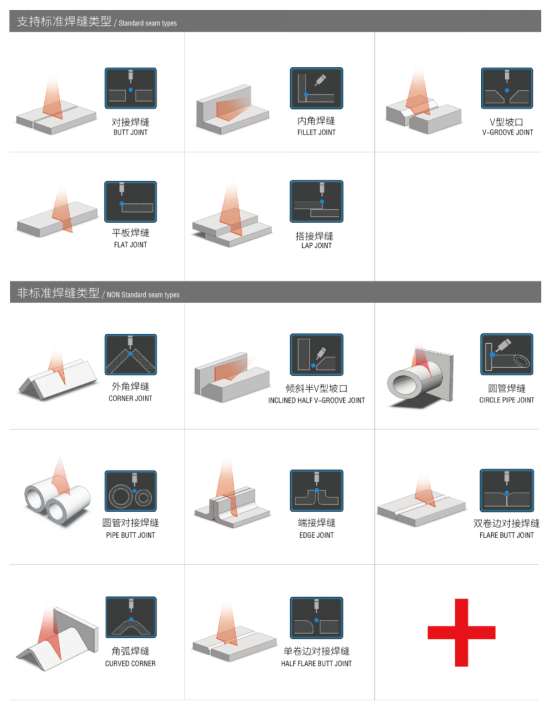
The technical team of Intelligentlaser Technology has more than 11 years of experience in the development of joints identification algorithms , and has established a complete algorithm library, which basically realizes full coverage of welding joints, At the same time, we can provide customers with customized algorithm development services.
Our laser seam tracking technology traces back to research introduced from Tsinghua University in 2013. Since then:
● We were the first company in China — and the 4th worldwide — to pass independent test verification by KUKA (2018).
● Our products hold 12 national invention patents, 30+ utility model patents, and 30+ software copyrights, and are certified under ISO9001 and CE.
● Our communication protocols now connect with more than 40 robot and controller brands, including KUKA, FANUC, YASKAWA, ABB, Panasonic, Staubli, UR, and JAKA.
● Since 2023, we've integrated deep learning into our visual algorithms, improving feature-point recognition on point-cloud data — most recently in our 2024 embedded laser vision sensor.
● We've supported 1,000+ customers across China, Europe, South America, the Middle East, and Southeast Asia, with engineering teams in Suzhou and Foshan and 24/7 after-sales support.
Our seam tracking sensors are deployed across a wide range of industries where weld quality and consistency directly affect product performance:
New Energy — battery shell and battery tray welding, including TIG with filler wire
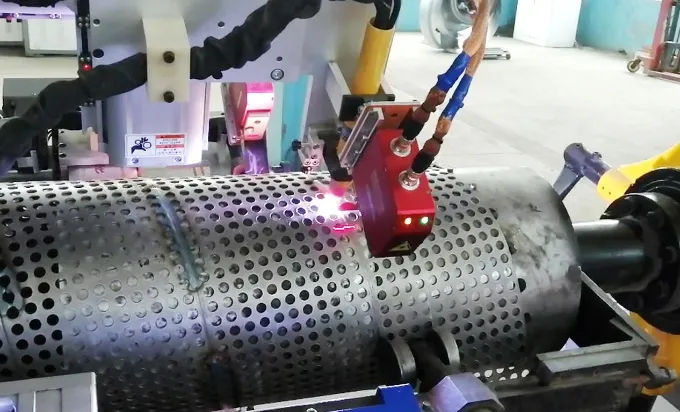
Pipe & Pressure Vessels — longitudinal and circumferential seams, steel-plastic composite pipe
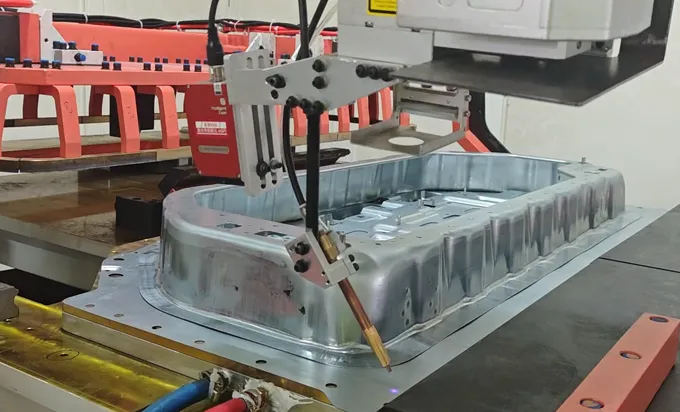
Auto & Auto Parts — friction stir welding of side panels and structural components
Power Equipment — transformer tanks and heat-exchanger assemblies
Engineering Machinery — heavy structural welds on excavators, cranes, and similar equipment
Aerospace — high-precision joints with tight tolerance requirements
Steel Metal and Steelwork — structural steel fabrication, lap/fillet/corner joints
Corrugated Plate — multi-seam pre-scanning for membrane walls and container panels

Related Application


Let Us Provide a Professional Solution for You Today
Our experienced team can provide customized service to all kinds of projects. Also, we provide 24/7 aftersale service.
Our aim is to make sure all customer can use the laser sensor after receiving it instead of put it in the box.