



Product Categories


General Seam Tracking & Seam Finding Sensor
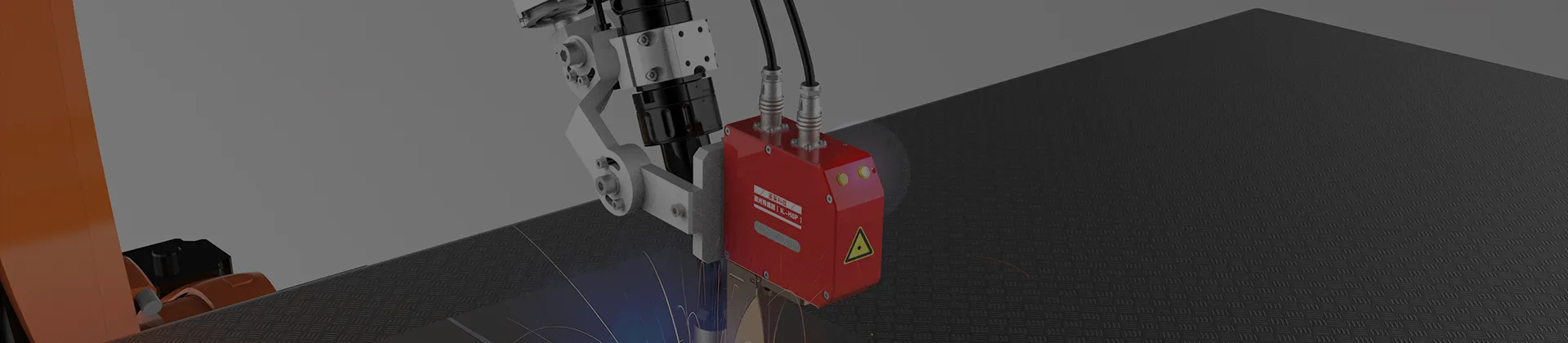
General Seam Tracking & Seam Finding Sensor is a series of product developed by IntelligentLaser. It is a high-speed and compact 3D laser vision system for real-time seam tracking such as laser welding, laser hybrid welding and laser brazing. It ensures to guide the robot to find the joint accurately. It is designed for robotic welding processes and it can be applied for all types of welding materials such as carbon steel, stainless steel, and aluminum alloys.
A seam tracking sensor and a seam finding sensor solve two related but different problems, and this series handles both. The sensor projects a laser line across the joint and reads its 3D profile through an integrated camera, using laser triangulation to calculate the exact position, width, and depth of the seam. That data is passed to our host control unit, which communicates directly with the robot controller or PLC in real time. The distinction between tracking and finding comes down to timing and how the correction is applied.
In tracking mode, the sensor scans just ahead of the torch while welding is in progress and continuously feeds joint position data to the robot controller. As the robot moves along its programmed path, it adjusts that path on the fly to follow the actual seam rather than the taught path. This matters because parts rarely sit exactly where they were taught: thermal distortion during welding, fixture wear, and normal part-to-part tolerance all shift the joint slightly from one workpiece to the next. Real-time tracking compensates for these shifts as they happen, which keeps weld bead placement consistent, reduces the rejection rate on parts with tolerance variation, and removes the need to slow the robot down "just in case" the joint has drifted.
In finding mode, the sensor scans the joint before the arc or laser starts, locating the precise start point and overall path so the robot can correct its program before welding begins. This is the better approach when the main issue isn't deformation during welding but inconsistent part placement going into the cell — for example when parts come from a stamping or casting process with natural dimensional variation, or when fixtures introduce slight rotation or offset from one cycle to the next. Seam finding eliminates the manual re-teaching that would otherwise be needed every time a batch of parts doesn't sit exactly as expected, and it's commonly used together with tracking for a complete pre-weld-and-during-weld correction workflow.
This series is specifically suited to laser-based joining processes — laser welding, laser hybrid welding, and laser brazing — in addition to standard arc processes. Laser processes are less forgiving of joint misalignment than arc welding because the beam is narrow and the process has little gap-bridging ability, so accurate real-time positioning matters even more. The sensor and algorithm in this series are tuned for the narrower tolerances and higher travel speeds typical of laser-based work, while still supporting carbon steel, stainless steel, and aluminum alloy, so the same sensor can move between projects without a hardware change.
Arc glare, spatter, and smoke are normal conditions in a welding cell, and they are also the conditions that cause cheaper optical sensors to lose accuracy. The anti-interference algorithm in this series is built to filter out arc and spatter noise as well as reflective interference from shiny or highly polished surfaces such as stainless steel and aluminum, which is one of the more common failure points for laser vision sensors in production. The result is a sensor that keeps reading the joint correctly even when the cell around it isn't perfectly clean.
Two Models, One Flexible Series
The series currently includes two models, the IL-PF170 and the IL-PF200, which differ mainly in field of view and optimal working distance. The IL-PF170 is suited to applications where the sensor can be mounted closer to the joint, while the IL-PF200 offers a wider field of view for setups that need more clearance between the sensor and the workpiece. Both share the same core tracking-and-finding logic and the same robot communication protocols, so switching between them doesn't require relearning a new system — see each model's page for full optical specifications.
Works With Your Existing Robot Cell
This series communicates with more than 40 robot and controller brands, including KUKA, FANUC, YASKAWA, ABB, Panasonic, Staubli, OTC, UR, and JAKA. If you're integrating into an existing cell rather than building a new one, the sensor is designed to be added without replacing your current robot or controller.
Where This Series Is Used
Because it's built for variety rather than one narrow use case, this series shows up across a wide range of fabrication work — general robotic welding cells in steel structure and engineering machinery, auto parts production, pipe and pressure vessel fabrication, and power equipment manufacturing, anywhere a shop welds more than one type of joint or material on the same line.
Backed by Independent Engineering
This series is built on technology that traces back to research introduced from Tsinghua University in 2013, and it carries the same engineering credentials as the rest of our range: 12 national invention patents, ISO9001 and CE certification, and recognition as the first company in China — and the 4th worldwide — to pass independent test verification by KUKA. We support the series with 24/7 after-sales service and engineering teams in Suzhou and Foshan, so if a sensor needs to be reconfigured for a new joint type or robot brand, there's a direct line to the people who built it.
What's the difference between this series and your Zero Gap or Sheet Metal series?
Those two series are built for one specific scenario — near-zero gap joints or thin sheet metal — while this series is built to handle a broader mix of joint types and materials, making it the better starting point if your shop welds varied parts rather than one repeating product.
Can this sensor be used for both arc and laser welding?
Yes. It's tuned specifically for laser welding, laser hybrid welding, and laser brazing, and it also supports standard arc processes on carbon steel, stainless steel, and aluminum alloy.
Do I need both tracking and finding, or just one?
Many projects only need one. If your main problem is part-to-part placement variation going into the cell, finding alone may be enough. If the problem is distortion or drift during welding itself, tracking is what solves it. Tell us your specific issue and we'll recommend the right mode and model.

Let Us Provide a Professional Solution for You Today
Our experienced team can provide customized service to all kinds of projects. Also, we provide 24/7 aftersale service.
Our aim is to make sure all customer can use the laser sensor after receiving it instead of put it in the box.